CAPTAIN POP. THE 688 COMEBACK SPECIAL
An interview with Brian Chin and Steve Roberts
Steve Roberts and Brian Chin first met in the early 1980s in Liverpool. Both were living in Wallasey, near New Brighton, on the Wirral. At the time, Brian was playing in a band called Edelweiss, while Steve was involved in several early bands, including the beginnings of 16 Tambourines.
They shared a flat in Wallasey, which became the foundation for their songwriting partnership. Brian joined 16 Tambourines for a while, playing keyboards and guitar, and contributed to the songwriting and arrangements, but before the band secured a record deal, Brian left to join another Liverpool group, Candy Opera. The Candy’s often shared stages with 16 Tambourines, and they remained close friends and occasional collaborators, collaborations that eventually evolved into Captain Pop.
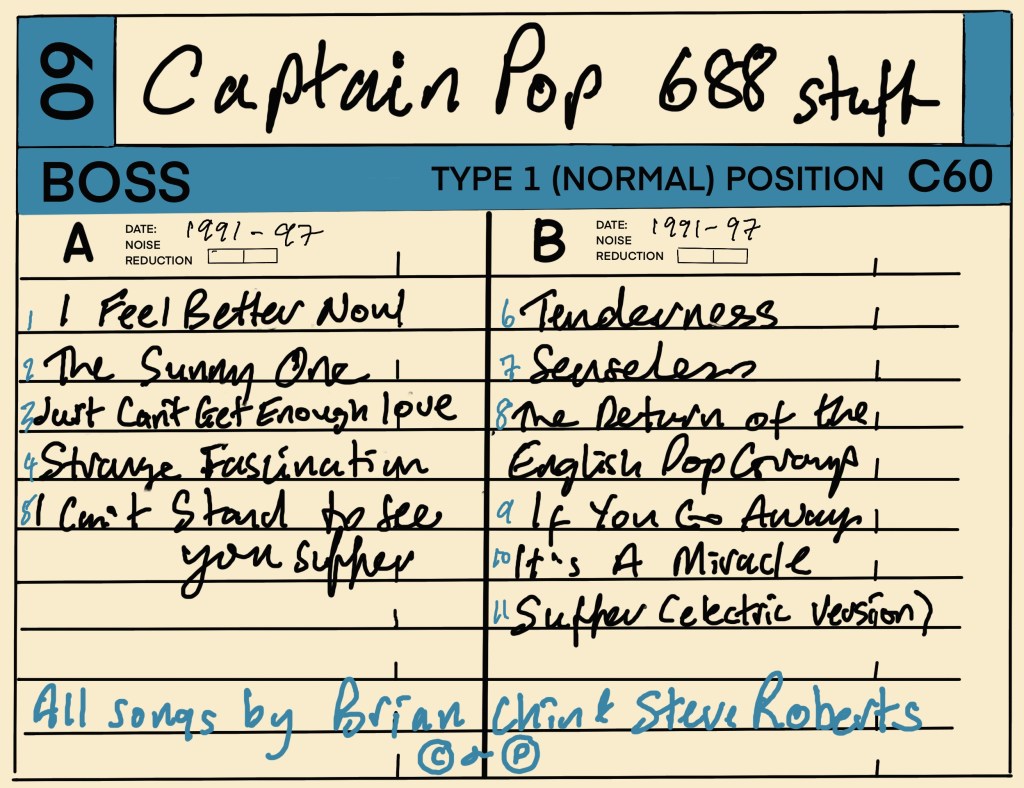
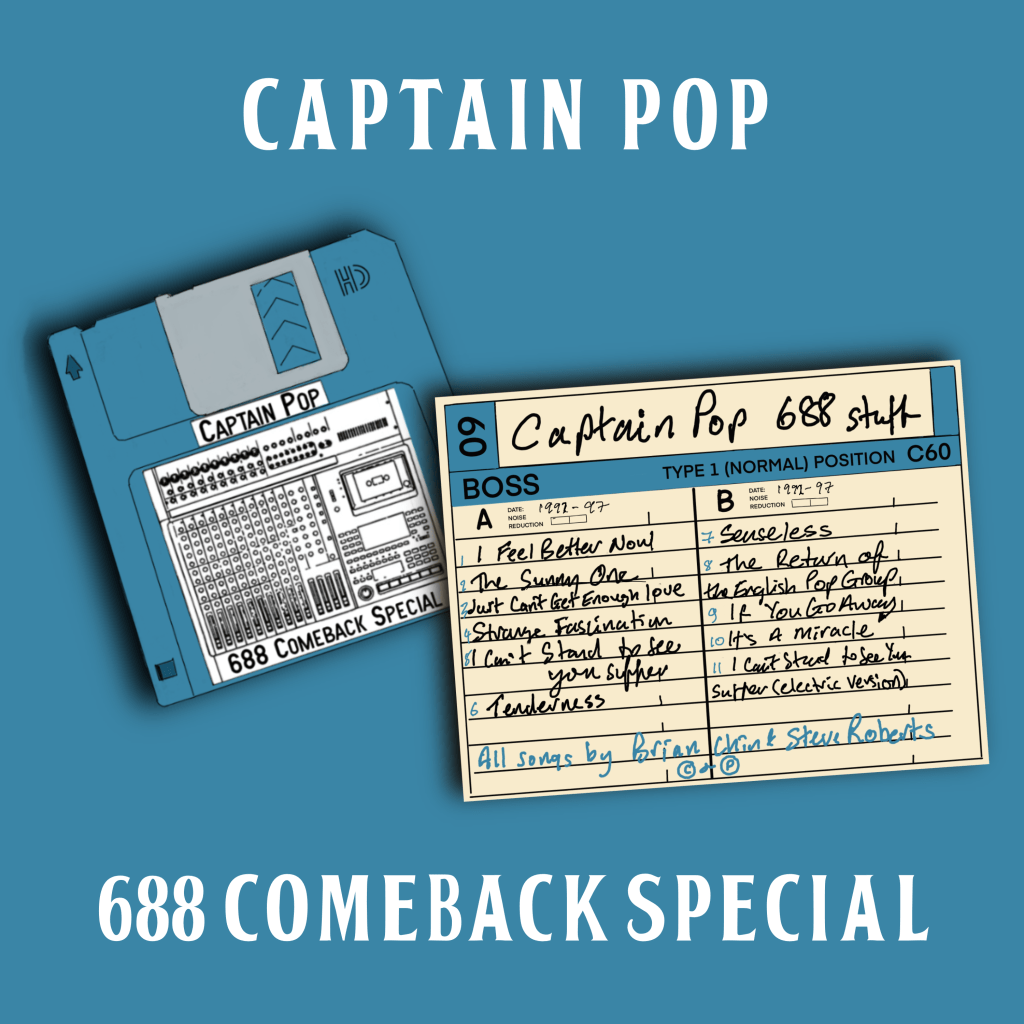
Steve’s music publisher at the time had bought him a Tascam 688 Cassette Porta-studio recorder, and it’s this machine that led to the album released this month on 9×9 Records: Captain Pop, the 688 Comeback Special. The songs were written by the duo in the 1990s and recorded generally on the same day day they were written, using whatever instruments were to hand. Usually an acoustic guitar, a cheap keyboard and drum machine. Last year Steve found the cassette ‘master’ tapes and so the process of fixing up the songs began.
Today, Steve lives in Derbyshire and Brian in Brighton. Though they’ve both moved away from Liverpool, they still regard themselves as Liverpool musicians and a Liverpool band. They continue to write together, albeit less frequently, sending each other ideas and developing songs gradually. The ties to their Merseyside roots remain strong, and the spirit of collaboration continues to define Captain Pop.
How did the rediscovery of the old recordings come about?
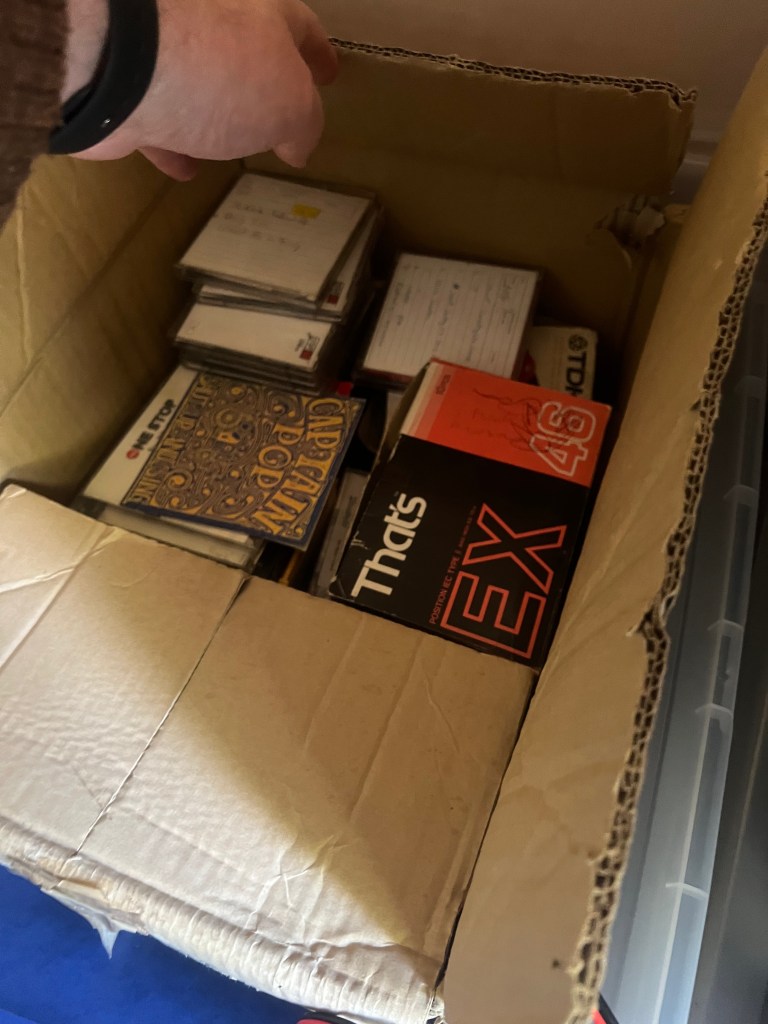
Steve: Well, it wasn’t quite as mysterious as a rediscovery. I always knew we had boxes of cassette tapes from the 688 writing sessions. Whenever I moved house those boxes came with me. They usually ended up in the attic, but I never really sat down and went through them properly.
From time to time, Brian and I would send each other old mixes we’d done back then, stuff we’d recorded onto cassettes. We’d say, “Ah, remember this one? That was a good song” That kind of thing, but I was busy with other stuff and never really thought to dig deeper.
When I moved into my current house, there’s this shed in the garden where I can store things. As I was sorting through boxes, I found the tapes again. A lot of them didn’t even have song titles written on them, just “688 stuff or similar scribbles. My biggest problem was finding something to play them on. Original 688 machines are really expensive now, and many are only good for spare parts. So I bought a second-hand Yamaha eight-track cassette recorder, not as good as the original 688, fewer features, but I thought it might do the job, and I picked one up on eBay for about £200.
When I put the tapes in, they did play, but everything ran slow, sometimes out of time, and the machine itself was temperamental. Sometimes it wouldn’t rewind or play properly. Then when I tried transferring tracks into the computer, each pass would run at a slightly different speed which meant the individual tracks were all out of sync and out of tune with each other.
To be honest, I was being a bit stupid until I realised I needed an audio interface that could handle all eight tracks at once. A mate, Simon, lent me one he had. It was pretty old and only worked on an old Windows laptop, but after a lot of trial and error, I managed to transfer some of the songs.
Quite a few, the hiss was too bad, or they cut out halfway, or they were just unusable. In the end, I salvaged maybe four or five songs beyond what made it to the album, but most of those weren’t fit for release.
After I’d managed to get the recordings onto the computer, Brian and I started talking about whether they were worth putting out, whether the quality was good enough. I sent them over to him, and that’s where the idea of releasing The 688 Comeback Special began really
Brian: It was all Steve’s initial inspiration, really. Over the years, I’ve thought fondly of our songs from that period and there were so many that hadn’t seen the light of day. Whenever I’d listen to some of my lo-fi digitised versions, with a ton of tape hiss still on there, I’d always wish we had got them done properly. So, when he suggested having a go at tidying them up, I was up for it.
What emotions did you feel when listening back to those tapes for the first time in
decades?
Steve: Well, some of the songs I already had copies of, just not very good ones, they were hissy old tapes, so there wasn’t a huge revelation with most of them. My first reaction was actually practical: “How am I going to do this? How am I going to get these transferred properly?” But there were a couple of surprises. One song in particular, Senseless, I had absolutely no memory of it at all. I’d forgotten we’d ever written or recorded it. Then there was a cover version we did of a Candy Opera song, and somewhere we’ve also got a cover of That’s the Way Love Is by Ten City.
There was some frustration, too, because I remembered certain songs we’d written and recorded, but I couldn’t find them on the tapes I was able to transfer. They may still be hidden on other cassettes that just wouldn’t play properly.
A lot of the emotions were less nostalgic and more about being perplexed. In a good way. I’d listen and think, “How did we write that? Where did it come from? How did we manage to write and record a whole song in five or six hours and it still sounds pretty good?” The arrangements weren’t bad, the tunes held up, some of the music is great, the vocals okay, and the lyrics, even if rough, had good ideas behind them. So no, I didn’t get weepy or overly nostalgic. I was just really pleased to find them.
Brian: Re-listening to them actually made me quite nostalgic and brought back the atmosphere of the times, when it felt like influences were coming in from all over the place. So much different stuff was feeding into our songwriting back then. At least, that’s what it felt like for me.
I was surprised by how much I liked Senseless after hearing it again recently. I didn’t like it that much when we wrote it, and it took somebody telling me they really liked it to make me have another listen with open ears… but it’s got a certain quality I can appreciate more now, although I’m not entirely sure what that is. There’s also something about the tone and mood of I Feel Better Now which still moves me in exactly the same way it did when we wrote it.
Why did you decide to preserve some of the imperfections rather than polish them?
Steve: Well, I suppose we did polish them a bit. I used some noise reduction software to take away a bit of hiss, and I tried to nudge things more in tune, but we could never get them exactly in tune. Beyond that, we didn’t want to overdo it as what we really liked was the freshness of those recordings, the spark of the initial idea. Normally, if you’re in a band, you write a song and can rehearse it, try out different arrangements, change melodies, tweak guitar parts, and all that. But with these songs, we didn’t do that. We didn’t have the time, although in a way we chose not to have the time. The whole point was just to write some good songs, not to overthink them.
The bit that might have made me a bit emotional, actually, was how strong those arrangements and songs were in their raw state. They just sounded fresh. That’s why we decided straight away: no overdubs, no piling on effects, no AI trickery. Just take what we had, clean it up enough to be listenable, and let the essence of the recordings speak for themselves.
Brian: By the 90s, we’d already developed a pretty comfortable way of working together and I remember Steve telling me something about letting your subconscious kind of take the reins initially when coming up with ideas, so it was kind of our ethos at the time to do stuff quickly. No over-thinking or planning, no faffing or mulling things over, just get it all out, whatever is in there, the same day, without coming back another time to finish an idea. So, these songs represent that kind of unfiltered, unedited creative approach and I kind of love it for what it reveals in that way. You look back afterwards and think, oh yeah, our subconscious minds did know more than we did.
How would you describe the dynamic between you two as co-writers?
Steve: We were kind of honest with each other. We could say, “No, that’s not very good,” or “I really like that,” or “maybe that needs to do this.” There was a bit of demarcation as well: Brian was mostly in charge of the music, I was mostly in charge of the lyrics, and we were both in charge of the melody and the arrangement. Once we had the initial idea, it could come from me, or from Brian, or just from us messing about and one of us going “I like that” we’d start shaping the song. We’d say, “okay, it goes blah blah blah, then it goes blah blah blah,” maybe the guitar goes like this, maybe the drums like that. Then I’d go and write the lyrics, Brian would start laying down instruments, and I’d sometimes play guitar. I might have played a bit of keyboard, but not much. Brian let me play a bit of guitar every now and then! Then we’d sing them together.
The dynamic was quite easy. I learned lots from Brian because he’s a really good musician. I’ve never considered myself a musician I’m a songwriter. Brian’s a really good musician, and I’m sure he considers himself a songwriter too. I learned loads from him. And I think Brian learned from me, from my way of going, “come on, let’s do this, let’s do that.” I was maybe a bit more straightforward, while Brian wanted to move things around more. So it was good, like a yin and yang thing. Two sides of the same coin, maybe. Greater than the sum of our parts. Fitted like a glove. Any cliché you want, really.
It was a good because we could look each other in the eyes, like John and Paul, and if it made us smile, we knew we had it. But we could also say, “No, that’s crap.” The other person wouldn’t get upset. They might argue their position, but they wouldn’t get upset. So it was a good dynamic.
Brian: We could be a bit like two old codgers arguing about trivia! We both have our strengths and weaknesses, Steve’s strong on the lyrics, melodies, overall song tone and structure and I’m a bit more into chords, counter melodies and rhythm. We overlap a lot as well. Sometimes we come together on the melodies and chords. But Steve seems happy for me to have space for things like beats, harmonies and counterpoint and I’m happy to leave the lyrics and structure to him. It seems to work well, with us giving each other a bit of space like that.
Steve, how did your experience in 16 Tambourines shape the way you approached Captain Pop?
Steve: I don’t know if it did shape it, really. I was kind of a bit bitter and twisted after 16 Tambourines, because we lost a record deal and I thought that was it, it was all over. For a while I even forgot how to sing and how I wanted to write. We had turned into The Tambourines, which was a lot more guitar-based. In 16 Tambourines I’d wanted to write about things, but with The Tambourines I decided, I’m not going to write about anything. I even wrote a song called Let’s Talk About the Weather.
For Captain Pop, I think it was different because we didn’t have time to edit or overthink. Brian would say, “Come on, we need lyrics,” and I’d just get on with it. That made the songs more personal. I also wanted to do something we hadn’t done before, so it became acoustic-based, partly out of necessity, but it felt right. It was nice to be acoustic, and it made the songs more heartfelt and instant.
By that point, I’d had enough of bands. Being in a band is difficult, and honestly, I didn’t want that anymore. So Captain Pop wasn’t a band. It was a songwriting partnership. I just wanted to write good songs. I think Brian’s style influenced 16 Tambourines so Captain Pop often feels like it carries his style, you know. I always liked the way Brian wrote, so that was a big part of it for me.
Brian, how did your time in Candy Opera influence your style in Captain Pop?
Brian: It’s all inextricably linked, I’d say… and a big part of my own musical development. From Edelweiss and 16 Tambourines to Candy Opera and Captain Pop, I wanted to contribute something to the bands’ sound and I’m just as much an admirer of Alan’s and Mal’s writing as I am of Steve’s. They’ve all given me so much from their unique perspectives, which inspires me to keep writing. So, even though these Captain Pop songs are quite a departure from that post- punk, Liverpool sound of early Candy Opera, I’m sure Mal’s influence on me has filtered in there somehow.
Mal’s approach to writing was coming from another angle. From his use of chords and melodic ideas to arrangements, tone and feel, I learnt so much from him. Plus, he introduced me to a lot of music I hadn’t heard before; Friends Again, Love and Money, Scottish bands on Postcard Records, stuff like that, so I guess I soaked up as much of his influence as I could, as I did with Alan in Edelweiss.
What was it like moving from Liverpool to living apart in Derbyshire and Brighton, and working remotely?
Steve: Well, we haven’t really done a lot of remote work, to be honest. Not long after I moved to Derbyshire, I went down and stayed with Brian for a weekend, and we wrote a song called Cheap Violins. After that, we’d sometimes send each other ideas back and forth, but we didn’t do loads, really. We put out a single When Will Times be Changing a couple of years ago and in 2006 recorded an album called Shut Up & Sing.
Brian had moved to Brighton before I left Liverpool, so he’d been there a few years. We stayed in touch, I’d send him things, he’d send me things, and it was, “Yeah, I like that,” or, “No, not so much.” But we didn’t actually finish a lot. The main thing was that we stayed friends and kept that musical connection alive, even if it was stretched a bit. We didn’t see much of each other in person, but we were in contact.
Brian: Well, it’s a bit more tricky for us to create in the same way these days, since we live about 300 miles away from each other. There’s no substitute for being in the same room as someone when you’re writing. We recently tried a new bit of tech, an app which allows you to see and hear each other if you’re in different locations but without the slight time lag you usually get on apps like Zoom, so it could work. We’ll let you know! Otherwise, it’s just us sending bits of ideas to each other and waiting for a response. I still try to use the same creative method these days when I’m writing on my own but listening to these recordings from the 90s, I do think we captured something special because of that spontaneity.
What’s next for Captain Pop after The 688 Comeback Special?
Steve: We’re not really sure, to be honest. We’ve got a couple of songs bubbling around, some we’ve written over the years, some we’re writing now, but we don’t quite know yet where it’s heading. We are big on melody, Liverpool is a town built on melody. What I do know is there won’t be any more archival projects as I sold the Yamaha eight-track
We’d also love to do live shows, ideally with a full band, but of course, it costs money, and since we live far apart, it’s a big commitment. Acoustic gigs are always a possibility in the near future, but in my heart I’d love to put a proper band together if we can ever afford it.
Brian: There are still a load more songs written in that period that haven’t been aired yet and I’d love to finally do them justice at some point. Plus, writing new ones. Our ethos for Captain Pop was always to keep the door open for new directions and styles.
Whatever direction we choose, though – big band jazz, sea shanties, funk disco (I can feel Steve cringing now, hahaha) – it’ll still be pop. Sometimes, I like pulling Steve out of his comfort zone just to see what he responds with!
The 688 Comeback Special is available now from 9×9 Records.
There is a Limited Edition Cassette and Compact Disc boxset and a stand alone Compact Disc version.
Also available on the streaming app of your choice.
 captainpop.co.uk